

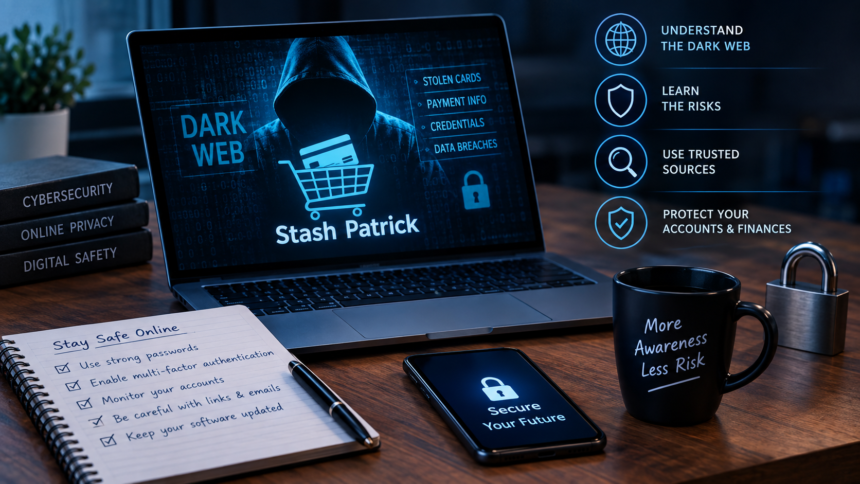
The dark web has become an increasingly discussed subject in cybersecurity, online privacy, and financial crime. stash patrick Terms associated with underground marketplaces can attract curiosity from people who want to understand how these hidden ecosystems work and why they present risks. Stash Patrick is a name that may appear in discussions surrounding underground payment-card markets and compromised financial information.
For beginners, exploring a topic such as Stash Patrick should focus on education, cybersecurity awareness, and responsible research. stashpatrick.cc Attempting to purchase, test, validate, or use stolen payment information is unsafe and potentially illegal. Fortunately, it is possible to learn about the subject through reputable research, security reports, and publicly available information.
This guide explains the broader topic while focusing on safe online research and practical protection against the threats associated with underground financial markets.
What Is the Dark Web?
The internet is often described using three broad categories: the surface web, deep web, and dark web.
The surface web contains websites that search engines can generally discover and index. News websites, public business pages, blogs, and online stores are common examples.
The deep web consists of online resources that are not normally indexed by search engines. Online banking dashboards, private email accounts, subscription services, corporate databases, and cloud-storage accounts are examples.
The dark web is a smaller section of online infrastructure designed to provide additional anonymity. Some privacy technologies used within this environment have legitimate applications, including protecting sensitive communications.
However, anonymity can also be abused. Certain hidden services have become associated with illegal activities, including stolen-data trading and financial cybercrime.
Understanding the Stash Patrick Reference
Stash Patrick may be referenced in online discussions involving underground marketplaces and compromised payment information. It should not be treated as a conventional credit-card provider, financial institution, or legitimate online marketplace.
The broader importance of such a name is what it can reveal about the underground economy surrounding stolen financial information.
Cybercrime can involve multiple specialized participants. One group may obtain information through phishing or malware, another may attempt to distribute it, and others may try to profit from the stolen data.
This division of responsibilities makes cybercrime more difficult to address because a single incident may involve several stages and participants.
For beginners, understanding this ecosystem is more valuable than attempting to interact with it directly.
Why People Research Underground Markets
Cybersecurity researchers, journalists, law-enforcement agencies, and security professionals may investigate underground marketplaces for legitimate reasons.
Researchers can study these environments to identify emerging threats, understand criminal business models, and determine how stolen information moves through criminal networks.
Journalists may investigate underground markets to explain cybersecurity risks to the public.
Security teams may monitor threat intelligence to determine whether their organization’s credentials or customer information have been exposed.
Law-enforcement agencies may investigate criminal infrastructure as part of broader efforts to combat financial crime.
These legitimate objectives do not require purchasing stolen information or participating in criminal transactions.
Safe Ways to Explore the Topic
Beginners interested in Stash Patrick or similar subjects should start with reputable sources.
Cybersecurity companies frequently publish threat-intelligence reports describing trends in stolen credentials, payment fraud, phishing, malware, and data breaches.
Government agencies and law-enforcement organizations may publish announcements about cybercrime investigations and marketplace disruptions.
Academic researchers also publish studies examining online anonymity, cybercrime economics, payment security, and underground communities.
These sources can provide valuable information without exposing users to potentially malicious websites or illegal transactions.
When researching online, it is also useful to compare information from multiple reputable sources rather than relying on anonymous forum posts or unverified claims.
How Stolen Payment Information Is Obtained
Understanding the origins of compromised information is one of the most useful parts of cybersecurity education.
Phishing is a common method. Attackers may create convincing messages that imitate banks, retailers, technology companies, or other trusted organizations.
Data breaches can expose customer information when attackers compromise business systems.
Malware can steal credentials or other sensitive information from infected devices.
Social engineering is another major threat. Attackers may manipulate people into revealing passwords, authentication codes, or payment information.
These methods demonstrate that financial security is not only a technical problem. Human awareness is equally important.
Risks of Directly Visiting Illicit Markets
People who attempt to explore underground marketplaces directly may encounter several dangers.
Some sites may contain malicious advertisements, phishing pages, or fraudulent downloads. Others may attempt to steal cryptocurrency, credentials, or personal information from visitors.
Criminal marketplaces can also be unstable. Operators may disappear, websites may be compromised, or platforms may be shut down.
Most importantly, interacting with stolen financial information can create serious legal and ethical consequences.
For beginners, researching the subject through reputable publications is therefore a much safer approach.
Protecting Your Own Accounts
Learning about underground financial markets should encourage better personal security.
Start with strong, unique passwords. Avoid using the same password across multiple services because a breach at one website could expose other accounts.
A reputable password manager can help users generate and store unique credentials.
Multi-factor authentication should also be enabled whenever possible. This adds another layer of protection if a password becomes compromised.
Email accounts deserve particular attention because they are frequently used for password recovery. Protecting email with strong authentication can help protect other connected accounts.
Protecting Financial Information
Consumers should regularly monitor bank and credit-card accounts for unfamiliar activity.
Transaction notifications can provide immediate warnings when purchases occur. Suspicious transactions should be reported to the relevant financial institution as quickly as possible.
Users should also be cautious about unexpected messages requesting financial information. Instead of clicking links in suspicious emails or text messages, users should open the official financial application or manually navigate to a verified website.
Authentication codes should never be shared with unexpected callers or messages.
What Businesses Can Learn
Businesses can also learn valuable lessons from underground payment-card markets.
Organizations should limit the amount of sensitive information they retain and restrict access according to job responsibilities.
Encryption can protect sensitive data during storage and transmission. Tokenization can reduce exposure of actual payment credentials during transactions.
Regular security assessments can identify vulnerabilities before attackers exploit them.
Employee education is another important component. Staff members should understand phishing, social engineering, suspicious attachments, and unusual authentication requests.
Businesses should also maintain incident-response procedures so they can act quickly if a security incident occurs.
The Importance of Responsible Research
Responsible cybersecurity research focuses on understanding threats without contributing to them.
Instead of attempting to purchase stolen information, researchers can analyze published threat reports, breach investigations, academic studies, court records, and government announcements.
Researchers should also avoid unnecessarily handling personal information obtained through criminal activity.
The purpose of studying underground markets should be to improve security, identify trends, and help organizations defend themselves.
How the Threat Landscape Is Changing
Cybercrime continues to evolve as technology changes.
Financial institutions increasingly use behavioral analytics, automated fraud detection, tokenization, biometric authentication, and stronger identity controls.
Attackers, meanwhile, continue to rely on phishing, social engineering, credential theft, malware, and other techniques.
This creates an ongoing cycle between attackers and defenders.
The disappearance of one marketplace does not eliminate the broader threat. Criminal groups may change platforms, communication methods, or techniques.
For that reason, cybersecurity professionals focus on underlying behaviors and attack methods rather than only individual marketplace names.
Building Better Digital Awareness
The best outcome of researching Stash Patrick is greater awareness of digital-security risks.
Users should understand how phishing works, recognize suspicious requests, use strong authentication, and monitor their financial accounts.
Businesses should invest in security controls, employee education, monitoring, and incident response.
Researchers should approach underground-market topics responsibly and rely on credible sources whenever possible.
These practices can reduce the opportunities available to criminals and make compromised information less useful.
Conclusion
A beginner’s guide to exploring Stash Patrick online should begin with a clear distinction between cybersecurity research and participation in an illicit marketplace. Understanding underground financial markets can provide valuable insight into stolen payment information, phishing, data breaches, and the economics of cybercrime.
However, directly accessing or interacting with criminal marketplaces can expose users to malware, scams, stolen data, and potential legal consequences.
The safer approach is to study the subject through reputable cybersecurity research, government information, academic publications, and security-industry analysis.
At the same time, the topic provides an important reminder about personal security. Unique passwords, multi-factor authentication, transaction monitoring, software updates, careful handling of suspicious messages, and responsible financial practices can significantly reduce exposure to online threats.
Ultimately, exploring the subject responsibly is about learning how cybercrime works so that individuals and organizations can build stronger defenses. The most useful knowledge is knowledge that helps protect financial information rather than information that enables its misuse.